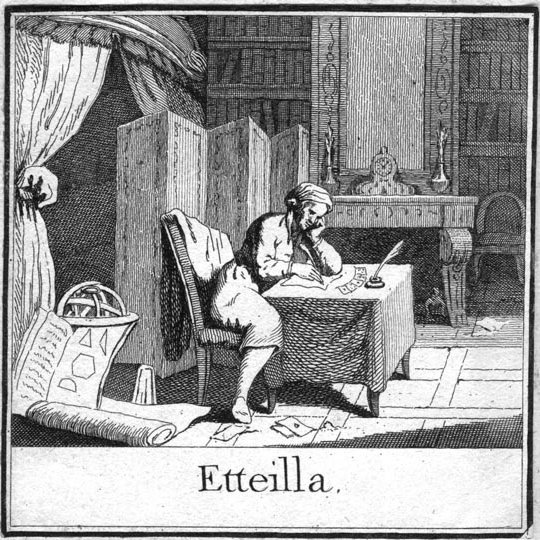
WHO WAS ETTEILLA?
For the last two years, I’ve been on a bit of a tarot quest. I set out to learn more about Jean-Baptiste Alliette and his cartomancy system, specifically the meanings he assigned to his 78-card tarot deck. First, of course, I’m begging the question here with an assumption that you’re familiar with this noteworthy figure in tarot history. But, perhaps not. So let’s begin there with a look at who Jean-Baptiste Alliette was.
For today’s students of tarot and tarot history, he’s known more familiarly as “Etteilla” — which is, you’ll note, simply his surname spelled in reverse. He carved a place for himself in cartomancy by developing a system of interpretation first for a “Petit Jeu” deck of 32 cards, and then, later with a system for the full 78-card tarot deck, complete with meanings assigned for both upright and reversed cards.
I don’t think it’s necessary to delve too deeply into his personal life story. We should note that he lived from 1738 to 1791, he was from France, and is said to be the first professional card reader, making his living through divination.
For me personally, “Etteilla” was little more than an interesting note in tarot history. While I find history fascinating in a general sense, where “card history” is concerned, I’ve never felt it necessary to teach it as part of tarot instruction. For those students who have an interest, of course, I’ve encouraged them to explore the history of tarot, but my position has always been that we can become proficient users of tarot without having a knowledge of their history. In fact, there are so many different ideas and uncertainties about the “origin” of tarot that trying to follow their development can quickly lead to confusion and frustration. Better, IMHO, to focus on learning how to best use the cards and to appreciate how they’ve evolved through the years to become meaningful to us in today’s modern world.
But then, somewhere, somehow, I was bitten by this little “Etteilla bug”. I became curious and wanted to know more, not so much about HIM as about the meanings he assigned to the 78 cards of tarot. Little did I know that I would soon find myself off on a quest which I didn’t even understand!
I read meanings. I reviewed Etteilla’s biography. I struggled through translations of his work. I threw up my hands in despair from time to time, and as often as not I wondered what possible reason I had for even wanting to pursue this avenue of study. What was I trying to accomplish?
Gradually I came to understand my reasons. Perhaps it’s a way to honor Etteilla or to acknowledge his contribution to the art of tarot, but my ultimate goal was to find a way to make his work relevant for today’s readers. Not an easy task.
I’ve stumbled and bumbled around on this twisted, turning pathway for nearly two years now, and it’s only been in recent weeks that I feel I’ve really started coming to terms with what I want to do. It’s only now that I’m seeing glimmers of hope that maybe it’s possible to bring Etteilla’s interpretations forward into the 21st century. Or maybe I’m just a bit delusional here.
As I continue my studies and my attempts to make Etteilla meaningful and useful, I’ll be chronicling the experience here. If you’d like to follow along, welcome. I don’t profess to be a scholar, but I do come to this project with curiosity and a sense of adventure. My ideas may seem foolish to many, and that’s all right. FOOLS can have fun, and for me, that’s what I’m doing here.
If you want more objective information about Jean-Baptiste Alliette, his life, and his work, here are a few online resources you can visit.
Etteilla – The First Modern Card Reader
Again, as a bit of a disclaimer here, I’d like to add that my work is NOT intended to be a scholarly study of Etteilla and his role in tarot history. What I hope to do is find relevancy in his ideas, to find ways to adopt his practices to make them “usable” for modern-day tarot readers. I make no claim for historical accuracy. My objective is simply to enrich my tarot knowledge, to share what I learn, and to give other readers an opportunity to expand their understanding of these beautiful 78 cards.
 Sabbats, Seasons, and Tarot Spreads
Leave a comment